
The School of the (IM)Possible
Art as a Catalyst for Greater Community Engagement
Teaching Artist:
Francine Kliemann is an interdisciplinary artist and theatre maker from Porto Alegre, Brazil, and is the founder and director of Platô Cultural.
- Location: Brazil
- Teaching Artist: Francine Kliemann, Platô Cultural
- Years Active: 2021-2022
- Number of People Impacted: 808
- Art Forms: Design, New Technologies, Imaginative Play/ Theatre
Teaching Artist:
Abner Torres Delina Jr. is a Filipino artivist, storyteller, performance
artist, educator and founder of multi-arts collective, BLACK CANVAS.
- Location: Philippines
- Teaching Artist: Abner Torres Delina, Jr.
- Years Active: 2022-2024
- Number of People Impacted: 260
- Art Forms: Performance, Theatre, Visual Arts
Local Issue Addressed
Florianopolis is a rapidly growing city on an island just off the southeast coast of Brazil. Due to climate change, parts of the island face flooding and clean water shortages exacerbated by conflicting attitudes to land development, resource management, and infrastructure planning.
Project Overview
Commissioned artist Francine Kliemann combined imagination and play to create The School of the (IM)Possible, a fictional an immersive roleplaying experience for children ages 8-9 at Santa Terezinha School in Florianopolis, Brazil. The project ran for 12 weeks beginning in 2021, and spread to 4 schools and 12 cohorts in Brazil.
In 2022, the School of the (IM)Possible expanded into 2 schools with 2 cohorts into North Lanarkshire, Scotland through a partnership with The Necessary Space. The project went on to win several awards and was introduced into the curriculum as a model of exemplary practice.
Activities
In the School of the (IM)Possible, students are immersed in an imaginary world through drama, role-play, and digital technologies. The Secret Organisation Synesthesia (S.O.S.) has traveled back in time to make contact with the first agents of the School of the (IM)Possible. Student-agents are invited to accept a secret mission to learn about how climate change is affecting their environment. After a time-traveling bookshelf mysteriously appears in the classroom (filled with still-to-be-written books from the future), a communication channel is opened with Massami Alamair, a scientist living in 2071 who invites them to join an (IM)Possible mission: to create sustainable solutions that will protect the future of their planet.
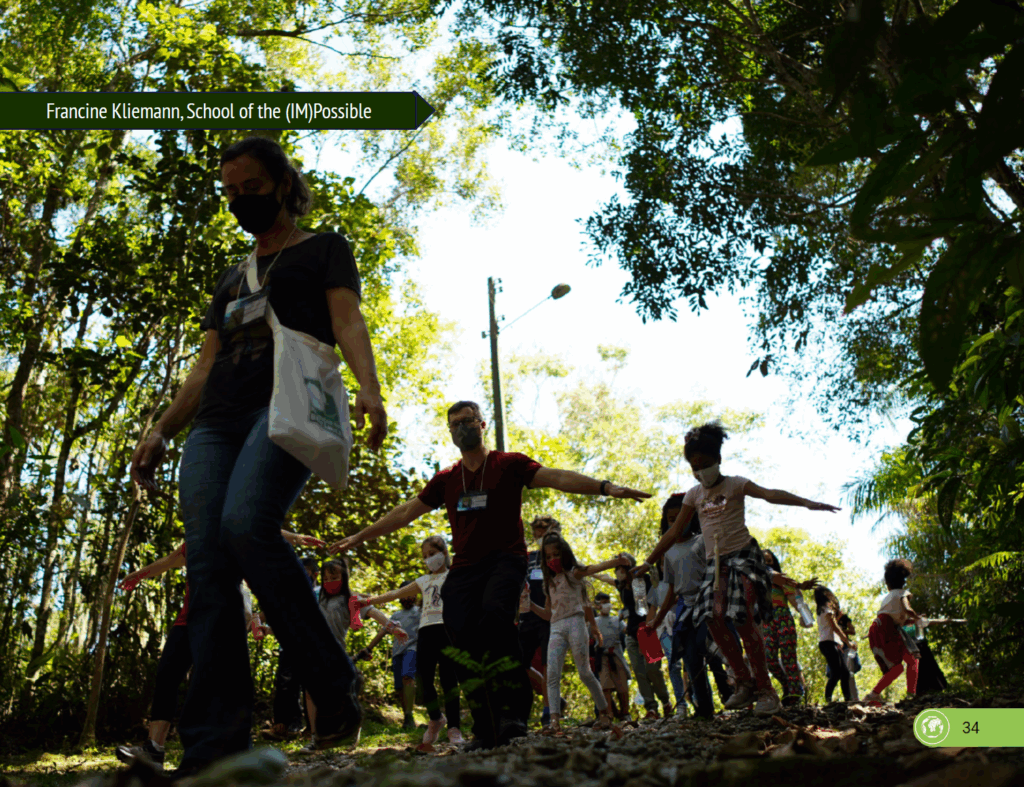
Guided by Massami Alamair and the interactive bookshelf, students visited a nearby nature trail to visit the “portal of the future” and were challenged to protect the portal by learning about environmental issues. The project culminated with a day of learning where the kids became the teachers and the adults took the role of the students to better understand their experiences and vision for a sustainable future, while challenging one another to commit to positive action.
Drama has a well-documented history of catalysing the imagination and asking participants to consider
different perspectives and motivations. This empathy-led approach to understanding complex systems and the individuals involved can be a fun and engaging way to help young people address challenging issues in new and innovative ways.
Social Impact Outcomes
Impact on Students and Teachers:
• Students developed their communication skills to better discuss climate change in their communities, and helped shift negative perceptions about nature and the environment to a more optimistic view.
• Teachers developed new capacities to integrate live and digitally immersive environments to improve student engagement.
Impact on the Future of the Project:
• The project went on to receive an International Collaboration grant from the British Council.
• The School of the (IM)Possible was awarded an Ashoka Fellowship.
• The teachers and the national education body now use the project as a model for embedding arts integration into the curriculum.
• Partnering educational institutions have now expressed a desire for continued training.
Skills and Competencies Measured
- Understanding the effects of climate change on the environment
- Communication and advocacy skills
- Action taken (participation, mobilization, and activism)
Data Collection Methods
- Interviews with teachers and students
- Student in reflection of artwork created
- Written responses
- Feedback forms
- Audio and video